The transcript below is for reference and reflects the full recorded conversation with minor edits.
Crypto Compliance Unfiltered: Regulation, Risks & Reality for Q1 2026
A Q1 2026 regulatory update with Joe Ciccolo, founder and president of BitAML and executive director of the California Blockchain Advocacy Coalition, covering SB822 digital asset unclaimed property reform, the Little Hoover Commission’s anti-fraud work and SB505, the July 2026 DFAL licensing rollout, and the state-versus-federal fight shaping prediction market regulation.
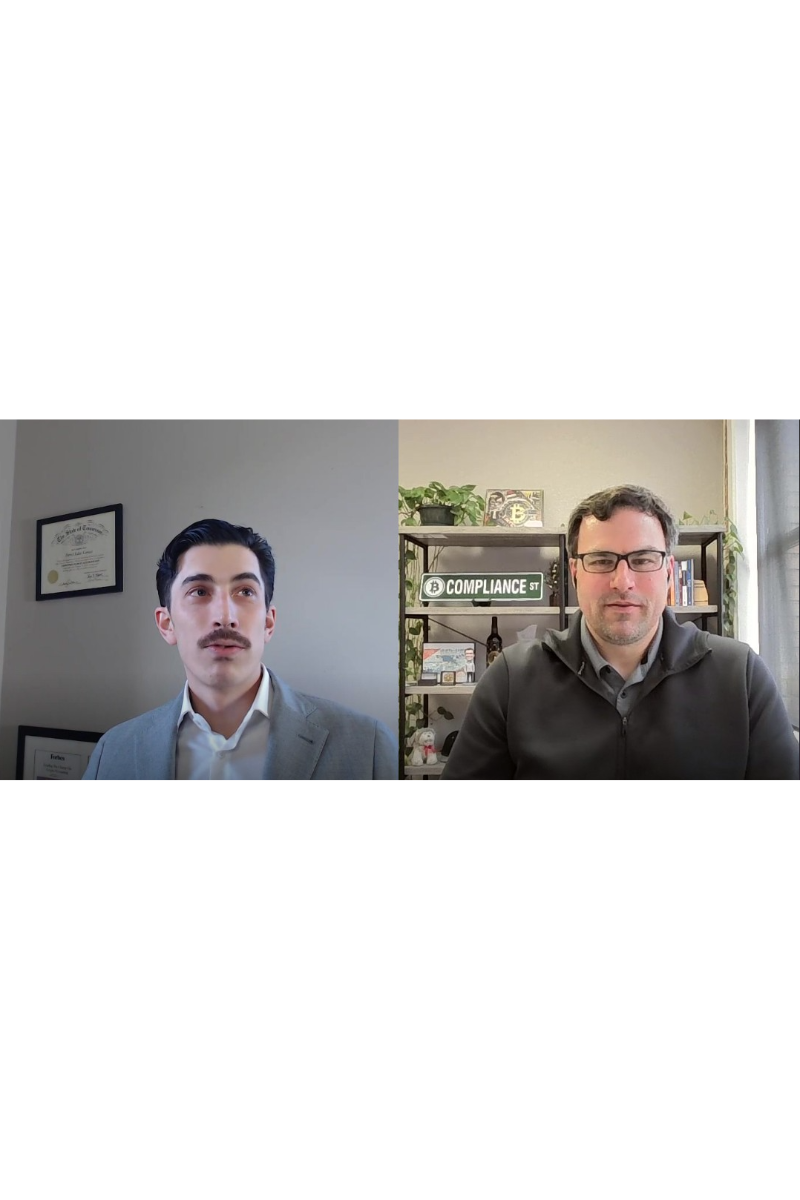
Host: Patrick Camuso, CPA, Camuso CPA |
Guest: Joe Ciccolo, BitAML & CBAC
Editor’s Note: The following transcript has been lightly edited for publication. Obvious auto-caption errors in proper nouns (Kalshi, FanDuel, DraftKings, DFPI) and a handful of clearly mis-transcribed words have been corrected for readability. All substantive dialogue is reproduced as delivered, with timestamps preserved as captured by the recording software.
Transcript
Patrick Camuso, CPA00:01.058Welcome to the latest episode of the Financial Frontier. I’m your host, Patrick Camuso. I’m very excited to introduce our guest today. This is a long time and recurring guest, Joe Ciccolo, founder and president of BitAML and executive director of the California Blockchain Advocacy Coalition. Joe, thanks for joining us here today.
Joe Ciccolo00:26.397Thanks Patrick, my pleasure.
Patrick Camuso, CPA00:28.212Absolutely. So, you know, you’ve been on the financial frontier several times and we’re excited to have you back. You you work in industry at BitAML, but you also do a lot of policy work through the California Blockchain Advocacy Coalition. So you have a unique perspective and that’s kind of what I want to give everyone listening here a glimpse into today and we’ll run through.
kind of a faster conversational style like some of our offline conversations maybe go sometimes. And we’ll discuss a few things that I think are top of mind and on your radar. And we’ll just go through them at a faster pace and kind of give people an overview on what does the regulatory landscape look like in California here in 2026 Q1. And there are a lot of moving pieces.
So, you know, I think one of the first things that we were discussing is California’s new crypto unclaimed property laws. Sorry about that.
So we’ll get into the first topic here. So California’s new unclaimed crypto property laws SB 822, I believe, right? So this was really interesting because I think California is the first state to actually add digital assets into their unclaimed property rules. And they did so in the final version of it in a way that was very tax effective. So can you give us a little bit of an overview on that?
Joe Ciccolo01:44.105Yes, that’s
Patrick Camuso, CPA02:03.503and what your perspective overall is on this.
Joe Ciccolo02:07.369Yeah, absolutely, Patrick. And you’re correct. It’s Senate Bill 822 or SB 822 for those that want to do a little extra research on their time. And I encourage you to do so. It is just that, as you mentioned, it’s updating the existing unclaimed property laws here in California to include digital assets. So for folks that are unfamiliar, unclaimed property laws, every state has them in place. Perhaps as a consumer, you might have seen TV ads where someone from state government or an elected official comes on and says, you might have a bank account or
Money you don’t know about, contact our number. The reason for that is that folks have abandoned property. Usually it takes the form of bank accounts. Maybe that’s a little bit more familiar to folks or other assets. Oftentimes someone passes away and it’s part of their estate and there was some miscommunication or they weren’t aware that their uncle had left them some money in a bank account. And because that bank account or other asset hadn’t been touched for a period of time on a platform,
there are obligations for that financial institution to transfer those funds to the state and effectively the state acts as a custodian for those particular funds. Now, these having been in place for decades, obviously, we couldn’t foresee cryptocurrency. This was pre-Satoshi. And so the rules needed to be updated. In California, we recognize that. What are we supposed to do with this property? So if you have an account with a centralized platform,
For example, Coinbase or Kraken, where those funds are being held in custody by that financial institution, by that crypto exchange. If you have not touched your account within a set period of time here in California, it’s three years. Other states, it’s three, five years. They obviously vary from state to state. You’re obligated as that platform to turn over those funds to the state, but only after you’ve had a set number of opportunities of outreach and potential engagement.
with that customer, it’s clear that they have abandoned their property, whether they know it or not. And those funds have turned over. And you mentioned the level of sort of pro crypto and pro consumer touches that were in this legislation. Very much so. So the reason for that, we in industry at CBAC in particular said, hey, we think that that property should be turned over in its native form, i.e. that crypto, whether it’s Bitcoin or some other token.
Joe Ciccolo04:29.961should be transferred to the state and held in its native form. In the original text of the bill, and you can go back and see the different versions that are all a matter of public record, in the original versions of that bill, it would have mandated that that exchange, so I’ll use Coinbase for example, since most folks are aware Coinbase, let’s say Coinbase, had an abandoned account there, effectively the state said, sell off that customer’s crypto and then wire us the amount in fiat.
creating, as I’m sure you know, Patrick, a taxable event that that consumer obviously didn’t authorize. And that allowed us actually to make the case based on tax and accounting implications that this isn’t exactly pro-consumer. are effectively the state is saying, hey, we want you to sell off this property that this person did not make that decision to do, send us the funds. And so you can picture an unfortunate situation if, as I believe, the price of Bitcoin is going to continue to certainly rise over time.
Someone could come in two, three years later, claim that property, go through the proper channels with the state, and the state would say, well, yeah, we sold your Bitcoin, and it was like worth 50,000 when we sold it. So here’s that. Wait a second. I just looked earlier today, it’s worth 90,000. but we sold it because we had to. So thankfully, cooler heads prevailed. Ultimately, the funds are kept in their native form. And that’s something that our members of our legislature, particular, author Senator Becker, who
is in the Bay Area, or rather is in Silicon Valley adjacent to the Bay Area, is very well aware of digital assets and ultimately saw, as we saw, that this is both pro crypto and pro consumer.
Patrick Camuso, CPA06:05.494Yeah, definitely. Like you said, it’s pro crypto in the way where the taxation is actually considered in the bill and the policy, which is extremely important. And it just shows a deep level of thinking. But also the other point that you made, it’s better if you believe in digital assets in Bitcoin and the price appreciation over time that you would want the asset provided to you in kind versus in fiat and losing out on the compounding growth.
And I think that this whole issue is, it’s great that California is doing it. hope more states follow suit here in the future because crypto obviously, you know, is an asset that to a large degree is owned by younger populations that are going to continue to get older. And the transferring of these assets to heirs is going to become more of problem as we go forward and more people are going to have to focus on estate planning.
But many that don’t may be leaving these assets on exchanges and having whoever inherits them have to access them. So I think that this is extremely important now. And as time moves on and the market matures and even the people holding the assets mature to a certain degree, this will become even more important.
Joe Ciccolo07:23.625Yeah, absolutely. One little sort of cherry to put on top of this Sunday here. I’m glad that there’s positive attention on this particular bill. We’ve actually heard from some of the larger exchanges in the crypto space have reached out to us and said, we actually like this bill from California, which is not always the case. You know, our legislature has a specific POV, but in this particular case, you know, we were given an AA minus by a lot of large larger exchanges in particular about this bill.
And now they are shopping it actively within other states, particularly blue states. So you can see the affinity for California, particularly among the blue states. But I think it could go to purple and red states as well, because it’s pro-crypto, it’s pro-consumer. And I think it crosses both sides of the aisle. Certainly the bill, when it passed, required both Democrats and Republicans to make its way through our legislative process and ultimately
It was a bipartisan effort. So we’re hopeful that not just blue states, but purple and red states or whatever color kaleidoscope we’re using now, regardless of state politics, that this is seen for what it is. It’s pro crypto and pro consumer.
Patrick Camuso, CPA08:34.338Yeah, I agree with you as pro crypto and pro consumer, which it should be able to extend to all sides of the aisle because at the end of the day, it’s going to be benefiting anyone that’s holding digital assets, including even, you know, the stakeholders like the exchanges as well. So, yeah, I think that’s fantastic. Let’s switch gears a bit because there’s a lot of moving pieces here in California and, you know, in another area that they’re focused on.
are fighting scams and you know not just in crypto because scams are not just in crypto right there in basically any industry or market that has value to it and has you know velocity of capital you’re going to start to find scammers and bad actors and crypto is certainly no exception to that as as as we all know and i think that california lawmakers are starting to escalate their responses to fighting some of these financial scams so
I think there’s some legislative mandates as well as some formal policy studies that are either in place or going to be put in place here shortly. Can you give a brief overview on some of that?
Joe Ciccolo09:44.787Sure, yeah, there’s definitely an active fight against scammers in California. There ought to be in every state, in my opinion, and even at the federal level as well. So in California, little context here, we have a sort of quasi-state independent research group called the Little Hoover Commission. And they are tasked with providing research and convening hearings and gathering information that will help inform potential legislation and or regulatory.
Patrick Camuso, CPA09:50.328Yes.
Absolutely.
Joe Ciccolo10:13.404rulemaking or regulatory adoption of different rules. So it’s comprised of commissioners who are generally retired, elected officials, or those that have been in public service and have the opportunity and the luxury of giving their time to help do these research projects and are maybe not necessarily looking to be elected to the next office, but are in the twilight of their career or off doing other things, which is great. So we can benefit from their knowledge.
on how the legislative and regulatory process works, but also their ability to gather constituents and build consensus. So it’s a great organization and not every state can boast of having a group like we have in California, the Little Hoover Commission. The state legislature here in California, about 20 or so elected officials got together and tasked the Little Hoover Commission with coming up with suggestions and ways that we can combat transnational scams and fraud, which was fantastic. And so…
You have these commissioners convening hearings that we at CBAC were pleased to be a part of. Some folks in the compliance world may know Erin West, Operation Shamrock. She testified. We had some various different district attorneys come in, different district attorney’s offices, I should say. And there were victims, advocates, and consumer groups. So was a wide kaleidoscope of different perspectives on how we thwart scams. And ultimately, we’re waiting. And we think about Q2 of this year.
We’ll see the report as a result of the hearings and extra research that the Little Hoover Commission did. And the goal was to help inform, again, as I mentioned, some sort of regulatory actions or legislation that could come forward. In the meantime, we do have a sort of, I guess, first crack at this in our legislature with Senate Bill 505. There have been various different adaptations of what the bill looked like in its original form.
it would have required financial institutions to reimburse victims of fraud induced transactions, which as you can imagine would be a little difficult and big heavy lift and the banks, not just crypto, but banks and other financial institutions came out against that. So this is little heavy handed. we can’t, if you’re saying in this legislation at the time, we can’t require a police report or these different steps, you know, this maybe isn’t the best approach. And so
Joe Ciccolo12:33.192The Senator Senator Richardson backed up a little bit said, okay Let’s let’s try something else and in its current form in this second year of our two-year cycle in California It was reintroduced as a bill that would mandate two-factor authentication for every login and prior to every transaction with the hope of helping to To to solve for at least curtail or mitigate, you know scam and fraud activities. So
That would apply in its current form to money transmitters and what are called digital wallets And so we’ll wait for the definition to come out but from our understanding This bill was aimed more so at Venmo PayPal Zelle those type of applications not wallets in the sense that us as crypto fellows might think about and so we’ve heard from the author that we that she recognizes and said so on the dais recognizes that there’s a separate set of
risk tolerances and several set of risk circumstances for crypto. And so in this case, they’re gearing this more towards those payment apps like Venmo, Zelle and PayPal. So we’ll see ultimately when that definition comes out and who it applies to. But again, this is part of that bigger picture of solutions and it’s not going to stop with this legislation. And there’s probably going to be other bills introduced or other tactics and other frameworks.
We applaud the members of law enforcement that presented and obviously our hearts go out to the victims that talked about their stories, talk about some sad moments in the galley, both myself and my colleagues there that were listening to these stories. You couldn’t help but feel for the victims, but hats off to the victims advocates and the members of law enforcement that were coming up with their own strategy and saying, well, legislation’s great and we’ll…
We’ll look forward to that, but in the meantime, we’re gonna fight the good fight. We’re gonna put some resources out there. We’re gonna counsel and help these victims. And we’re gonna prosecute to fullest extent of the law, the bad guys that are perpetrating these crimes.
Patrick Camuso, CPA14:38.542Yeah, you know, the two factor authentication almost seems like it should be something like a standard industry practice to a certain degree. So I think that makes sense. I’m interested to see what will result from the Little Hoover Commission in terms of even pushing forward more initiatives. Obviously, you know, it’s going to be tough to…
curtail it, would imagine there’s other low hanging fruit to stop different forms of fraud. Do you have any thoughts on that? Like what are some of the other low hanging fruit or some of the areas that likely will be a focus going forward?
Joe Ciccolo15:22.216Sure, I think there’s a lot that industry can do on its own and anything from, you know, scam warnings and proper disclosures and having safeguards in place to verify customers. And no one understand their financial dealings, which I guess is the textbook definition of KYC, right? Not just onboarding and validating ID. There’s very important reasons we do that and that should be in place. understand the customer and what makes sense for that particular customer. And we’ve worked with countless companies that
have amazing controls in place. They’re like, wow, this is great that you’re proactively putting these in place and thinking outside the box, calling out to customers that are 60 years of age or older before they do that first transaction and understanding is someone putting them up to this. I have some very tech savvy members of my family who are past the age of 60 and would not take offense to that. In fact, they look at that as a positive. Hey, this is
this institution is looking out for me. I think I want to do business with a company that cares about me. So less about the friction and less about the focus of putting someone off by this particular question, far from it. I think it’s the opposite. It shows that level of care. And so there are definitely some low hanging fruit that industry can put in place now. I think for on the other side of things, looking at law enforcement, I think really surrounding themselves with solid education and closing that knowledge gap.
working with industry, which we’ve seen a lot of great collaborations between industry and law enforcement. Many of those have been put on full display on LinkedIn and other social media platforms for all to see. And I think that as more information gets out there and more members of law enforcement become tech savvy or rather younger members of law enforcement join and bring with them their tech native approach to resolving issues and investigating crimes.
I think that’s going to help close the knowledge gap. I’m really, really encouraged by what I see, you know, Operation Shamrock, I mentioned earlier, and Erin West and her team doing some amazing work there and allowing that to cascade across the board. I’m not too worried about federal law enforcement. They seem to have closed the knowledge gap pretty quickly and have a lot of resources and assets at their disposal. I’m more worried about the smaller police departments and law enforcement agencies that might not have the resources or don’t have a key catalyst or key mover.
Joe Ciccolo17:46.992in that department or in that agency that help move them towards a more tech-focused approach and close that knowledge gap on the digital asset side.
Patrick Camuso, CPA17:56.014Yeah, and lot of it is a knowledge gap, like you said, across law enforcement and the end user. And to a certain degree, it starts to become the industry’s responsibility and the platform’s responsibility to start trying to clear that gap when we see such widespread issues related to the fraud. I think that’s likely to see, we’re likely to see some of that come out of this, like you’re saying, which I think will be great. I’ll be interested to hear some updates on that. As that starts to develop,
Joe Ciccolo18:28.133Absolutely
Patrick Camuso, CPA18:28.334So next let’s switch gears a bit into a big topic here California digital financial assets law the acronym that people may see for this is DFAL Which is scheduled to go live this summer on July 1st and it is a
Joe Ciccolo18:33.352Alright.
Patrick Camuso, CPA18:53.036large undertaking from my understanding, a comprehensive state level licensing and oversight regime for crypto businesses. So can you give us a little bit of a perspective on that and maybe some of the challenges associated with implementing it, whether it’s just the overall scale of it or how it’s going to interact with federal rules and laws as well and what the overall time that looks like.
Joe Ciccolo19:21.16Sure, that’s a lot of questions. I’ll try to unpack that and certainly come back if there’s a detail we want to focus on a little bit more. So for those that are unfamiliar, defal or digital financial assets law, that is the crypto licensing and oversight regime here in California. It was passed through a series of two bills combined together, AB 39 and SB 401. SB 401, the latter of the two bills I mentioned, that is specific to crypto kiosks, crypto ATMs, and it’s largely already in place.
Patrick Camuso, CPA19:23.63Yeah.
Joe Ciccolo19:50.345transaction limits and fee caps and other specific reporting for kiosks. So while that’s still in place, I’m going to focus on the other half of Defal, which is probably where this question is aimed at, and that’s the actual licensing through AB39. So in AB39, there is a comprehensive licensing regime specifically for digital asset financial platforms and providers. And that goes live, as you mentioned, July 1st of 2026.
It’s been pushed back a number of different times because of logistics and as you kind of alluded to, Patrick, the sort of the Herculean lift, I can quote, Chair Grayson, the Herculean lift that’s behind setting up a new licensing regime from whole cloth. So it is a huge undertaking. There are any number of different crypto platforms and companies out there that are willing to have to get a license and they have to their application in.
by July 1st. So there was some confusion just to alleviate that concern. It’s not having a license awarded by July 1st. It’s having your application submitted by then. Which leads us to the next question. Well, where do I find the application? Well, the application has not been published yet. So the DFPI is still working on that. And the reason that that’s still in flux largely has to do with the goings on in So there’s a discussion about a market structure bill. I know there’s a lot right now in the news with respect to
different elements of that stablecoin yield and we can pick apart the different parts of the bill but at the end of the day not having known whether a market structure bill is going to go through and if there’s going to be preemption or or what part the states can and cannot do has left sort of a deer in the headlights phenomenon here in California where hey this is going live July 1st but we don’t necessarily want to put an application out there because we may have to retract or move some things back in and I think the last thing they want is for an applicant to
to submit an application only to have to resubmit it later on. And, well, wait, I was first. Do I now have to go to the back of the line? And so you can see why there some logistical issues and snafus that could result from being too quick. On the downside, not knowing what they’re looking for in the application has left a lot of companies trying to figure out, how do I best position myself? The good news is that the DFPI, which is our state regulatory agency here that’s executing on defal,
Joe Ciccolo22:12.328They’ve already put out a comprehensive checklist of things to repair. They have a good resource page. They’ve already started putting some information out there. And in our conversations with the leadership of DFPI, they’ve been pretty consistent in saying, look, know, the legislature did a lot of the work for us. And what they meant by that is if you actually look at Assembly Bill 39, AB 39, a lot of what is required is actually written into law. Now, of course, there’s tactics and
and rulemaking and where the rubber meets the road, you what exactly does this look like in an application? I understand that. But at the end of the day, if a lot of that has been already articulated into the bill, you get a pretty good idea of what’s required. And I think that any crypto exchanger or exchange platform, OTC desk or other impacted party worth their salt that has already been through the state licensing process kind of has an idea of what something looks like when they see it. And they say, I think I remember that from
the other states that I’ve applied in, or gee, that looks pretty consistent. There’s a lot of parity there. So I think that there is valid concern of why don’t we have an application yet? But I think that there are some things that you can control as a platform out there in the marketplace where you can surround yourself with the available information and give yourself that head start. And then ultimately, before we know it, we’ll be off and running. And hopefully, we’ll have some clarity, no pun intended, from Washington, DC, so we know what’s going to happen here in the great state of California.
Patrick Camuso, CPA23:37.676Yeah, and I agree with you, you know, and with their approach overall, you don’t want to create an administrative burden of multiple applications due to some sort of change that takes place. So it’s much better to defer that and have it be done once and done correctly. And the companies that need to go through these processes have compliance teams that shouldn’t be able to be familiar enough with the requirements to be well prepared to submit the applications within a reasonable timeframe.
Yeah, I agree with that. So, you know, shifting gears into another big topic that, you know, I’ve seen you focused on at BitAML, it’s even starting to touch, Camuso CPA a bit, and that is prediction markets. So, you know, this is an interesting topic that is not that simple when it comes to the regulatory landscape. So,
Joe Ciccolo24:07.666Well said.
Patrick Camuso, CPA24:35.598Why don’t you give me a bit of your perspective on the regulatory landscape related to prediction markets from your side of everything and then maybe I’ll give a little bit input on the tax side of things there too.
Joe Ciccolo24:53.318Yeah, sure. Yeah, we’ve definitely gone sort of down the rabbit hole of prediction markets here at BitAML. And I appreciate you following us on that. We’ve published a two part series on our blogs and have been pretty, prolific on social media and elsewhere and talking about the advent of prediction markets. It’s pretty popular now. It sort of turned the mainstream. One could argue with the presidential election about a year ago and then
more recently being featured or parodied, I should say, on South Park. I suppose that’s a litmus test for how you know you’ve made it in pop culture is the creative writers of South Park have woven you into their storyline of what the characters in South Park are up to. yes, so prediction markets, are regulated based on, or we have some regulatory sort of feelers in terms of where this is going.
Patrick Camuso, CPA25:27.182Yeah.
Joe Ciccolo25:48.403Kalshi, perhaps one of the most well-known platforms, and there are some others out there that are maybe trying to strike out their own, blaze their own trail, I should say, but let’s follow Kalshi. About two or three years ago, they approached the CFTC and made the case for, and ultimately were eventually licensed through the CFTC as futures contracts.
So it’s not what we think of. We think of prediction markets, the first thing people look at is like, it’s like gambling, right? You you pick a, you wager on something and something happens. Well, if you go to their website, you’re not going to see references to bets or wagers, right? It’s the nomenclature because they are selling futures contracts on one side or the other. And so they’re regulated in a similar way as a derivatives marketplace, which of course, if you ask the average person, they’d go, well, that sounds very Wall Street.
You know, that sounds like a bunch of investors do that. You that doesn’t touch me. I’m betting on, you know, tonight’s football game. Right. And so it’s a completely different mindset. And arguably the reason they went down this path and good for them for realizing, hey, there’s a regulatory door. I can go straight through and not try to, know, sort of, you know, weave my way into the fabric of this marketplace and pretend I’m something I’m not. And then, I got caught and maybe I’ll pay a fine and do something else. No, the folks at Kalshi said, hey, we’re going to go
straight to the CFTC and submit our application. can’t imagine the analysts that opened that envelope or that email and said, what is this, right? But fast forward to today, here we are. The plus side to that for the folks at Kalshi in particular that blazed this trail through CFTC is that they’re regulated at the federal level versus the patchwork quilt of state gaming licenses that one must have to obtain. So if you think about the sports betting apps like
FanDuel and DraftKings, know, they’re state by state. I’m taking state by state gaming licenses, although more recently, they’ve decided to either acquire prediction markets or create their own prediction markets. And you can see why that would be appetizing from a regulatory arbitrage standpoint. Wait, I have one regulator in D.C. And let’s not kid ourselves, the CFTC is a very tough agency, right? You’re dealing with a lot of paperwork. And I alluded to this earlier. I think it was like two or three years.
Patrick Camuso, CPA27:50.839Interesting.
Joe Ciccolo28:07.324that Kalshi had to go through that process all while making no money because they didn’t have anything operational. And so there was a lot of faith that they had to put into their process and the team behind that. So the sort of apps are looking at this in our sports betting apps, excuse me, are looking at this and saying, you we could have all these different state regulators that we have to not only obtain a license, but then maintain that license through ongoing examinations and reporting, or we could go through one centralized authority.
with the CFTC. So you can see why they maybe wanted to hop ship and go over to the prediction market side and organize themselves around the constructs of a prediction market and futures contracts where you’re effectively saying yes, no to a particular outcome. I will add that these prediction markets are a little bit more mainstream in the sense that there can be about not just political events, although that’s kind of where they’ve made their name, and sporting events, which are kind of a big deal, but also around pop culture events and
Who’s going to win what award for best picture? And when is an artist going to meet the top 20 or something like that? Things that everyday Americans look at and have some sort of affinity for. I don’t follow celebrity or pop culture. Don’t ask me those questions. But I know a lot of people do. And I’m maybe more interested in sports. So they’re able to cast a wider net of consumers out there.
Patrick Camuso, CPA29:26.744Yeah.
Joe Ciccolo29:32.871Unfortunately, that’s led to a little bit of friction, as you might imagine. There’s a lot of litigation going on right now where particularly land-based casinos are getting involved in litigation, whether they’re tribal or corporate, are getting involved in litigation with their respective state attorney general’s office or other regulatory agencies at the state level saying, hey, you can’t let these guys operate in our state. They don’t have a state gaming license like we do. And so there’s a little bit of friction there. We saw the…
Most recently in the Commonwealth of Massachusetts, they were able to successfully argue before a judge and effectively ban, at least at this point in time, pending an appeal, ban these prediction markets in the Commonwealth. And then more recently, Portugal put a ban in place too. So some of these are going to be temporary and maybe lifted, and there’s going to be an appeals process. And I’m not a lawyer, and I’m not going to play one on this podcast. But I do think that this is going to
to play out in the court system. And my ultimate prediction, no pun intended, would be that there will probably land on something in between. But maybe it’s not a gaming license. I think either a regulatory framework or a legislatively induced framework is going to come about for these prediction markets where there is some sort of state level oversight. States tend to focus, and this is true for those in crypto, states tend to focus on consumer protection and the consumer experience.
whereas at the federal level, tends to focus on protecting the marketplace. So the CFTC seems very abstract to the average consumer, and probably so because they’re looking at liquidity, the financial health, the ability to effectively carry out the contracts, transparency in the marketplace. Those are things that the CFTC is focused on. And those are all great things, but very little touches the consumer. And I think that those involved in casino and gaming and even the gaming apps have been able to make the case, well,
you who’s looking out for the consumer, who’s looking out for problem gamblers or addiction or consumers that don’t quite know what they’re getting themselves into. You know, that’s something that we in the casino space have been doing for decades. And there’s case law and there’s there’s training and there’s there’s reporting obligations that we have. you know, here’s some abstract, you know, sort of federal framework for futures, you know, commodities, futures trading that is supposedly applying to someone who is placing a $200 bet on the big game tonight.
Patrick Camuso, CPA31:58.114Yeah, and that’s where you’re saying there may need to be some sort of new framework where it’s not gonna fit necessarily as the definition of gambling, but there’s gonna need to be some consumer protections and other things like that that may start to get filled in at the state level. So it’s very interesting to see where this goes going forward because it’s really not clear right now what the final form of this is gonna be from a regulatory standpoint. And like you said, there’s a lot of different.
regulatory agencies and stakeholders at the table and a lot of this is going to get decided in court. So we’re going to have to be watching that very closely and really from a tax perspective. It’s not very different either. It’s not really clear tax treatment on that side and there’s already practitioner divergence on how they’re treating these transactions for taxpayers where some of them may be treating it as gambling. Some may be treating treating it as capital gains events for when you you exit the contracts.
And some may be applying Section 1256 treatment on platforms like you mentioned, Kalshi, that are regulated by the CFTC, which it’s still not clear what the tax treatment there is going to be, even if you’re on a regulated platform like that, without further guidance from the IRS from a tax perspective, because these payouts are based off of events versus fluctuations in prices of an asset.
you start to get into these, these technical tax considerations on that side. So, you know, much like crypto, there is a lot of controversy over who’s going to regulate and have oversight over these types of transactions and assets. And this then leads into the tax side of things where you need to decide what is this asset, what type of transaction is taking place, and then take a tax position for that. And as you’ve alluded to, I mean, over the last
year or two, these markets have really proliferated. you know, now there’s tons of taxpayers that are starting to realize that they may have made a entry into a lot of contracts and have to take a tax position and be able to defend that tax position with the IRS. So that’s a whole secondary problem that I think people are going to just start to really start facing, you know, this tax season and that may carry forward as well. So
Patrick Camuso, CPA34:24.364Very interesting topic overall, and I think a very fitting topic for the financial frontier too, because this is kind of like you said, the next stage of financialization of everything. And on these prediction markets, there’s basically something for everyone, whether you’re into sports, politics, or any other type of current event, or the pop culture and all that stuff.
very interesting overall. So I know it’s something you’re gonna be watching closely and me as well from a tax perspective to really see where this all goes.
Joe Ciccolo34:59.516Absolutely.
Patrick Camuso, CPA35:01.356So Joe, this has been a really great conversation. Do you have anything coming up Q1 like any event you’re going to be going to or anything like that? Or are you just more focused on continuing publishing through BitAML and on LinkedIn? Where’s the best place for everyone to find you here during Q1?
Joe Ciccolo35:21.64Sure, yeah, think Q1, it’ll be more behind the computer screen and on social media and LinkedIn and Instagram and all the major platforms. Folks want to go on bitaml.com, B-I-T-A-M-L.com. You can connect to our socials there. We have a newsletter. We’ve gone from weekly to three times a week, and we’re looking forward to going to daily in the not too distant future, providing updates on…
different market goings on in terms of policy and regulation and then adding our own sort of highlights and perspectives on different things going on with respect to digital assets and public policy, digital assets and regulation and compliance best practices. So yeah, the legislature being back in session here in California is keeping us busy here in Q1. I do anticipate we’ll be traveling in the not too distant future. But yeah, stay tuned and we’ll anytime that
Myself or our team or sponsoring or speaking at different engagements, both virtually and in person. So it a great way to connect with folks. I love answering compliance questions and whether that’s in person or through the magic of the internet. We always love connecting with people and talking on these amazing topics on the frontier.
Patrick Camuso, CPA36:39.682Well, would encourage everyone to follow your LinkedIn. We put out great content on there. I know you recently, like we mentioned earlier, you did this, the series on prediction markets, which is on your website, which is extremely informative. you know, follow Joe on LinkedIn and definitely check out his website. There’s a ton of information there and I know you’re very open to connecting and talking to people as well. So, you know, if there is a need or a policy question, definitely reach out to Joe.
You know, Joe, this was a great conversation. I know it’s a busy Q1 for you because there is a lot going on on the policy side. So I hope to get you back on soon and maybe we can have some more updates around some of the topics we discussed along with likely some new developments by the next time you come back here on the financial frontier. So again, I encourage everybody to go and check Joe’s website. Go check his LinkedIn.
get connected with him if it makes sense. On my side, I’m going to be speaking at ETH Denver next month, so I’ll be in Denver in February. So if anyone is going to be out in Denver, feel free to drop me a message as well. And I’m happy to meet with you out there. And to everybody watching, I hope that this was an insightful episode. I know it was for me. This is packed with regulatory updates.
There’ll be many more of these to come in this format. Drop some comments below if you took some value from this conversation today or if there’s any other policy or regulatory topics you want to see us discuss next time. Joe, thanks again for being a guest. I appreciate coming on and looking forward to having you back here shortly. Until next time, I’m Patrick Camuso, signing off.
Resources Mentioned in This Episode
Joe Ciccolo’s firm website:
bitaml.com. BitAML publishes a newsletter and a two-part series on prediction market regulation. The California Blockchain Advocacy Coalition (CBAC) represents the cryptocurrency, blockchain, and Web3 industry before the California Legislature, Governor’s Office, and state regulatory agencies.
Work with Camuso CPA
Camuso CPA is a boutique accounting and advisory firm that focuses exclusively on digital asset tax compliance, Web3 accounting, and advisory for investors, funds, and operating companies. Our team advises clients on the full spectrum of issues discussed in this conversation, including prediction market tax characterization under Section 1256 and alternative frameworks, digital asset unclaimed property implications, and state-level compliance considerations for exchanges and OTC desks.
Schedule a consultation at
camusocpa.com/crypto-cpa.
About the Host
Patrick Camuso, CPA is the founder of Camuso CPA, a firm specializing in digital asset tax compliance and Web3 accounting. Patrick is a recognized thought leader in crypto tax practice and a speaker at industry events including ETH Denver.
Disclaimer: This transcript is provided for educational and informational purposes only and does not constitute legal, tax, or accounting advice. Views expressed by the guest are his own and do not necessarily reflect the positions of Camuso CPA. Readers should consult qualified professional advisors regarding their specific circumstances before acting on any information contained in this transcript.




 BitAML